

Have you ever found yourself wondering whether what you’re experiencing is OCD or anxiety? You’re not alone. Many people struggle to understand the difference between OCD and anxiety because the two conditions share overlapping features, especially when it comes to intrusive thoughts, worry, and physical tension. Still, there are clear distinctions, and understanding them can help you move toward the right type of support.
Let’s break down OCD vs anxiety in a simple, clear, and reassuring way.
A Quick Look: Anxiety vs OCD
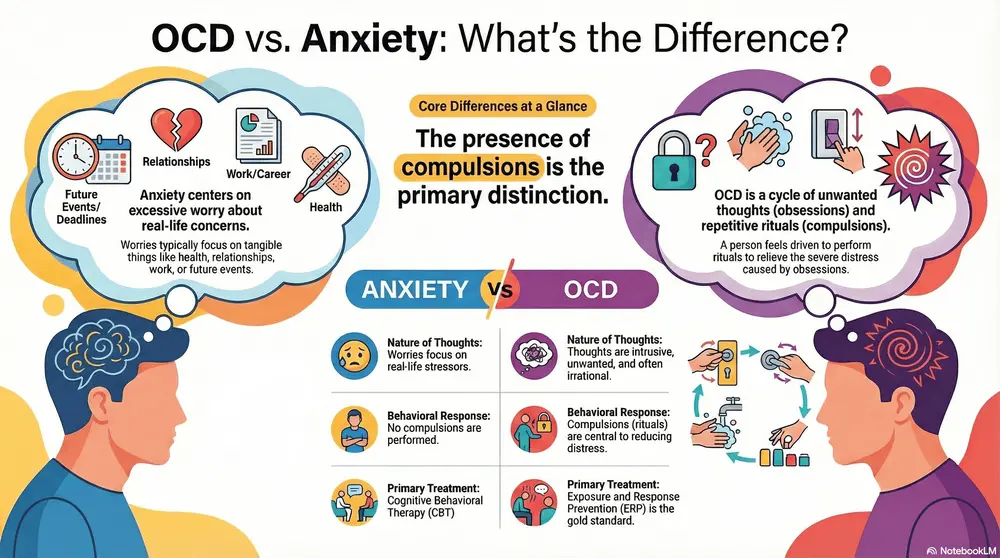
At first glance, anxiety disorder vs OCD can look similar. Both involve persistent worry, distressing thoughts, and emotional discomfort. But the core of each condition is different:
- Anxiety disorders center on excessive worry and fear about real-life concerns (health, relationships, work, future events, etc.).
- OCD (Obsessive-Compulsive Disorder) involves unwanted intrusive thoughts (obsessions) and repetitive behaviors or mental acts (compulsions) done to relieve distress.
Understanding these foundational differences is the key to telling signs of OCD vs anxiety apart.
What Is Anxiety?
Anxiety is a natural human response. But when it becomes intense, constant, or overwhelming, it develops into an anxiety disorder. This includes conditions such as generalized anxiety disorder (GAD), panic disorder, and social anxiety disorder.
Common Anxiety Symptoms
Anxiety symptoms often include:
- Persistent and excessive worrying
- Restlessness or feeling “on edge”
- Muscle tension
- Sleep disturbances
- Racing thoughts
- Difficulty concentrating
People experiencing anxiety and OCD symptoms often describe anxiety as a sense of constant anticipation, like waiting for something to go wrong, even when everything is fine.
What Is OCD?
OCD involves a loop of obsessions (repetitive, intrusive, unwanted thoughts) and compulsions (behaviors or repeated actions designed to reduce anxiety caused by those obsessions).
Common OCD Symptoms
- Obsessions: intrusive thoughts, images, or urges
- Compulsions: checking, counting, cleaning, repeating, mental rituals
- Difficulty stopping these thoughts or behaviors despite knowing they are not logical
- Significant distress or disruption to daily functioning
A person with OCD may spend hours trying to neutralize thoughts or impulses that feel threatening, even when they intellectually understand that those thoughts aren’t real dangers.
OCD vs Anxiety: The Key Differences
Although both conditions involve worry and intrusive thoughts, there are unique behavioral patterns in OCD vs anxiety that help distinguish the two.
1. Nature of Thoughts
- Anxiety: Thoughts tend to focus on real-life stressors—finances, relationships, health, upcoming events.
- OCD: Thoughts are often intrusive, irrational, or disturbing. The person knows they are illogical but feels compelled to neutralize them.
2. Role of Compulsions
- Anxiety: No compulsions are required to ease anxiety.
- OCD: Compulsions, physical or mental, are central. The person feels driven to perform them even if they don’t want to.
3. Trigger Patterns
- Anxiety: Worries fluctuate based on life events.
- OCD: Thoughts and compulsions create a repetitive cycle, often independent of external events.
4. Duration of Distress
- Anxiety: Stress is often related to specific situations.
- OCD: Distress builds from intrusive thoughts and rituals, which can consume hours.
Similarities Between OCD and Anxiety
Despite their differences, there are notable similarities between OCD and anxiety:
- Both involve intrusive thoughts
- Both cause physical symptoms like tension and restlessness
- Both can interfere with daily life
- Both create avoidance behaviors
- Both involve fear-based thinking
Because of these similarities, people often wonder about anxiety vs OCD intrusive thoughts, but intrusive thoughts in OCD tend to be more repetitive, unwanted, and tied to compulsions.
OCD and Anxiety in Relationships
Relationships are a common area where both conditions overlap.
Relationship Anxiety
This form of anxiety includes:
- Worrying about being “good enough”
- Fear of abandonment
- Over-analyzing partner’s behavior
Relationship OCD (ROCD)
ROCD involves:
- Intrusive doubts about your partner or the relationship
- Repeated checking or reassurance seeking
- Mental compulsions (reviewing memories, analyzing feelings)
This makes relationship anxiety vs relationship OCD an important distinction, anxiety involves worry, while OCD involves intrusive doubt + compulsive responses.
Can You Have Both OCD and Anxiety?
Absolutely. Many people experience OCD and anxiety disorder at the same time. Anxiety can exacerbate OCD symptoms, and OCD can trigger anxiety. Because of this overlap, accurate OCD and anxiety diagnosis is essential for choosing the correct treatment.
What Causes These Conditions?
Both conditions are influenced by:
- Genetics
- Brain chemistry
- Stress
- Learned behaviors
- Personality traits
Neither condition is anyone’s fault, and both are highly treatable with the proper support.
Treatment for OCD and Anxiety
While the conditions are different, their treatments often overlap, with important distinctions.
1. Therapy
The most effective therapies include:
- CBT (Cognitive Behavioral Therapy)
- Exposure and Response Prevention (ERP), especially for OCD
- Mindfulness-based therapies
ERP is considered the gold-standard treatment for OCD, helping individuals face intrusive thoughts without performing compulsions.
2. Medication
Treatment may include:
- SSRIs
- Anti-anxiety medications
- Other psychiatric medications if needed
Medication should always be considered in consultation with a licensed professional.
3. Lifestyle Approaches
These can support recovery:
- Healthy sleep
- Reducing caffeine and alcohol
- Exercise
- Stress management techniques
But they are not replacements for professional care.
If you’re looking for treatment for anxiety or treatment for OCD, a mental health professional can help tailor the right approach based on your symptoms and needs.
Professional Support in Texas
If you’re in Texas and feel you may be experiencing symptoms of OCD or anxiety, seeking professional guidance can bring clarity and relief. At the Center for Integrative Psychiatry in the Dallas–Fort Worth area, Dr. Tahir Khawaja provides compassionate, evidence-based care for individuals facing these challenges. The clinic offers in-person appointments in DFW and virtual visits across Texas, making support more accessible wherever you are.
If you relate to any of the symptoms discussed above, don’t hesitate to reach out and book an appointment. Getting help is a strong and empowering step forward.
FAQs
1. How to Know if You Have OCD or Anxiety?
The main difference lies in compulsions. If you experience intrusive thoughts and feel driven to perform specific behaviors or mental rituals to reduce distress, OCD may be present. Anxiety involves worry but not compulsions. A professional evaluation can provide clarity.
2. Can You Have Both Anxiety and OCD?
Yes. Many people experience both conditions at the same time. They share overlapping symptoms and can intensify one another.
3. Is OCD a Form of Anxiety?
OCD is related to anxiety disorders but is classified separately because it involves intrusive thoughts and compulsions, which are not present in typical anxiety disorders.
4. Can Anxiety Cause OCD?
Anxiety doesn’t cause OCD, but chronic stress and anxiety can worsen OCD symptoms or make intrusive thoughts more frequent.
5. Is Overthinking OCD or Anxiety?
Overthinking is more commonly linked to anxiety. OCD involves intrusive, unwanted thoughts followed by compulsions, not just excessive rumination.
Medical Disclaimer
This blog is intended for educational purposes only and should not be used to diagnose any mental health condition. If you are experiencing distressing symptoms or believe you may be dealing with OCD, anxiety, or any other mental health concern, please consult a qualified mental health professional. For personalized evaluation and treatment, contact a licensed provider or reach out to a trusted healthcare resource in your area.
This article is for education and general information. It isn't a substitute for individual medical advice, diagnosis, or treatment from a qualified clinician.
Webmaster
Articles on this blog are educational resources from the Center for Integrative Psychiatry, a multidisciplinary clinic offering evidence-based psychiatry, therapy, TMS, and integrative care for Texans since 2015. They are not medical advice — always talk with your own clinician about your care.
Meet the CIP team