When traditional medications or standard talk therapies fail to provide complete relief from focus challenges, emotional dysregulation, or chronic anxiety, exploring non-pharmacological alternatives is a logical step. As brain-training technologies gain attention across modern wellness and clinical psychiatry, many patients find themselves asking: does neurofeedback work, and is it truly worth the investment of time and resources? Understanding how this computerized biofeedback modality retrains electrical brain activity is essential for establishing realistic expectations and choosing an effective treatment path.
Does Neurofeedback Work and What Does the Clinical Evidence Show?
Neurofeedback works as an effective complementary therapy for improving self-regulation in conditions like ADHD, anxiety, and PTSD. Clinical trials show that through repeated sessions, the brain learns to produce healthier brainwave patterns, leading to sustained improvements in focus and emotional control when integrated with comprehensive psychiatric care.
When evaluating neurofeedback does it work in real-world clinical practice, the medical consensus is that it functions best as an adjunctive modality rather than a standalone miracle cure. Decades of electroencephalography (EEG) research demonstrate that individuals with mood or attentional disorders exhibit measurable electrical dysregulation in specific cortical regions. By targeting these irregular patterns, patients learn to consciously shift their brain state toward calm focus.
Clinical literature highlights that outcomes depend heavily on clinical oversight, proper protocol design, and consistent attendance. Brain training operates much like physical physical therapy, requiring sustained repetition to build lasting neural pathways. When combined with psychiatric guidance and lifestyle adjustments, many individuals experience meaningful reductions in symptom severity and functional impairment.
How Does Neurofeedback Therapy Work to Retrain the Brain?
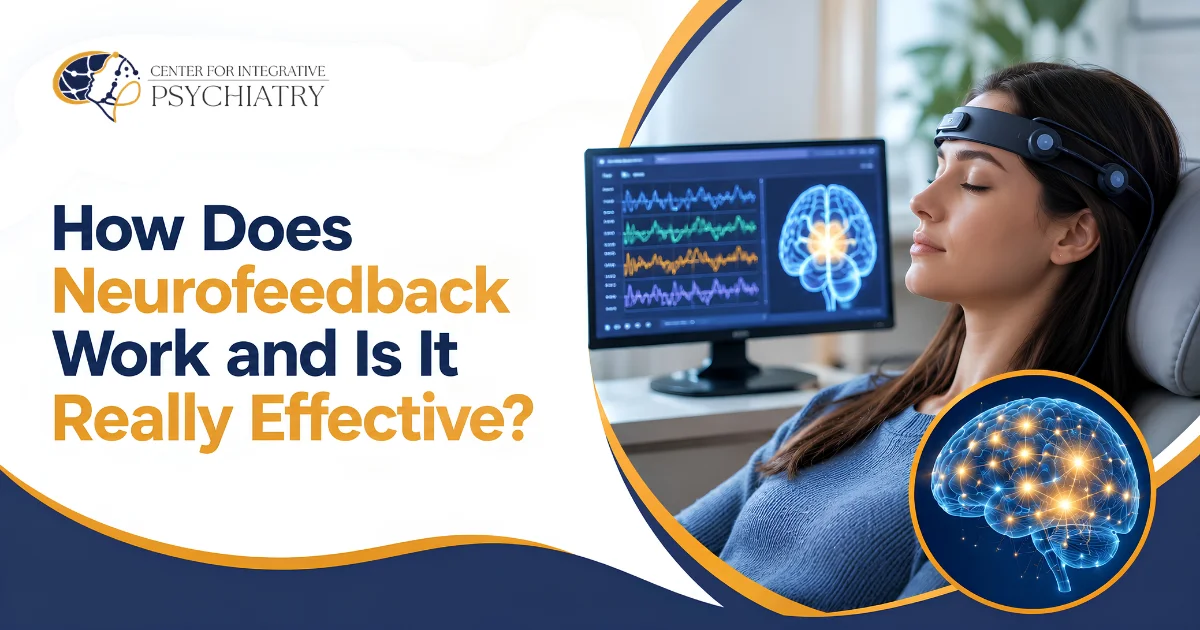
Understanding how does neurofeedback therapy work begins with electroencephalography sensors that measure brainwaves in real time. When your brain produces target frequencies associated with calm focus, the system delivers positive audio or visual rewards. This operant conditioning trains neural networks to self-regulate without sending any electrical currents into your brain.
To understand what does neurofeedback do at a physiological level, imagine providing your central nervous system with an instantaneous mirror. The human brain constantly generates electrical impulses categorized into different frequencies, including delta, theta, alpha, beta, and gamma waves. When an individual struggles with attention or chronic stress, certain frequencies dominate at inappropriate times.
Sensors placed gently on your scalp read these subtle voltage fluctuations and translate them into visual graphics or auditory cues on a computer screen. For a beginner-friendly explanation, read the overview of neurofeedback therapy and how it works. Several key mechanisms make this learning process possible:
- The system records electrical signals passively from the scalp surface without transmitting any energy or currents into brain tissue.
- Software analyzes whether your brainwaves match desired target thresholds, such as elevated sensory-motor rhythm or suppressed slow theta waves.
- When your brain reaches optimal frequencies, a video plays smoothly or audio tones sound clearly to provide instant positive reinforcement.
- If your brain drifts into dysregulated patterns, the video dims or the audio pauses, prompting your brain to unconsciously correct its state.
Through thousands of micro-adjustments during every visit, your brain learns to replicate these balanced firing patterns automatically throughout daily life. Over time, these reinforced pathways become the nervous system's default state even in challenging environments.
What Is Neurofeedback Therapy Used For in Clinical Practice?
What is neurofeedback therapy used for across mental healthcare? Clinicians utilize neuro feedback therapy most commonly alongside treatments for attention deficit hyperactivity disorder, generalized anxiety, post-traumatic stress, and chronic sleep disturbances. It serves as a targeted non-pharmacological tool that helps stabilize dysregulated brainwave frequencies associated with chronic hyperarousal or cognitive sluggishness.
Because electrical brain rhythms influence how we focus, relax, and regulate emotional impulses, training those frequencies offers broad clinical utility. Providers frequently recommend brainwave training for individuals who experience intolerable side effects from prescription medications or who desire non-pharmacological support.
Clinical research and outpatient psychiatry routinely apply this modality across several primary conditions. Each clinical application targets specific brainwave irregularities associated with patient symptoms:
- Attention Deficit Hyperactivity Disorder (ADHD), where training helps suppress excessive slow theta waves and boost beta waves to improve impulse control and sustained attention.
- Anxiety disorders and panic conditions, by reinforcing calming alpha waves and reducing the physical hyperarousal driven by high-frequency beta rhythms.
- Post-Traumatic Stress Disorder (PTSD), helping survivors regulate hyperactive amygdala signaling and transition out of continuous fight-or-flight survival modes.
- Chronic insomnia and sleep disruptions, by training the brain to transition smoothly from active daytime beta states into restful delta and theta frequencies.
By treating dysregulated electrical rhythms, neurofeedback addresses the physiological foundations that often undermine behavioral coping mechanisms. Restoring this neurological baseline makes psychotherapy and daily problem-solving significantly more effective.
What Are the Primary Benefits of Neurofeedback?
The main benefits of neurofeedback include improved executive attention, reduced physiological panic, better sleep quality, and long-lasting neural self-regulation without pharmacological side effects. Because the training leverages natural neuroplasticity, the coping skills and electrical stability gained during treatment typically persist long after formal training protocols are completed.
One of the greatest advantages of brainwave training is its gentle, non-invasive profile. Unlike systemic medications that circulate throughout the bloodstream, brain training causes no gastrointestinal distress, metabolic shifts, sexual dysfunction, or physical dependency. Patients remain fully alert throughout the process, exercising their own neural circuitry in a natural way.
Patients and healthcare providers frequently observe multiple functional improvements throughout a course of care. These positive changes often build progressively as sessions accumulate:
- Enhanced cognitive focus and working memory, allowing individuals to complete administrative tasks and academic assignments with greater efficiency.
- Greater emotional distress tolerance, reducing the intensity of sudden irritability, mood swings, and stress reactivity.
- Sustainable improvements that often remain stable years after training ends, because the brain has physically reinforced new synaptic connections.
- Increased self-efficacy and confidence, as individuals realize they possess the innate biological ability to calm and focus their own minds.
These compounding benefits make brainwave training a valuable asset for long-term psychological resilience. By strengthening internal regulation, patients often find they can handle unexpected life challenges with greater composure.
What to Expect During Neurofeedback Sessions and Treatment
During standard neurofeedback sessions, patients sit comfortably in an ergonomic chair while scalp sensors monitor electrical brainwaves. You engage with a video game, movie, or audio track that responds dynamically to your brain state. A complete neurofeedback treatment plan typically requires twenty to forty sessions to produce lasting neural conditioning.
Attending an appointment is straightforward and painless. A clinical technician cleans small areas of your scalp and applies non-invasive sensors using a water-soluble conductive paste. These sensors are purely passive receivers; they do not emit electrical impulses, shocks, or magnetic fields.
Each training appointment follows a predictable structure designed to keep you relaxed and engaged. Clinicians tailor the environment to ensure optimal focus and sensory comfort throughout the visit:
- You settle into a quiet room and watch a monitor displaying chosen media, such as a nature documentary or a responsive video puzzle.
- The system reads your continuous EEG data and delivers real-time auditory or visual cues whenever your brain enters targeted frequency zones.
- Appointments typically last between thirty and forty-five minutes, allowing you to return to work, school, or routine responsibilities immediately afterward.
- Clinicians periodically review progress data and adjust frequency thresholds as your brain demonstrates increasing stability and competence.
Because learning requires repetition, most patients complete two or three appointments per week over several months to ensure gains become permanent habits. Consistency is key to converting temporary neuroplastic changes into enduring neural pathways.
Personalized Neurofeedback Training and Psychiatric Care at Texas CIP
For individuals seeking specialized, evidence-informed brain training in Texas, the Center for Integrative Psychiatry provides an elevated standard of patient-centered care. Texas CIP recognizes that brainwave training is not a magical cure-all, but an effective clinical complement when integrated into a comprehensive, multidisciplinary psychiatric plan.
At Texas CIP, every prospective patient begins with an honest, unhurried clinical evaluation to determine whether neurofeedback is a sensible addition to their wellness routine. Training is provided in person at our Coppell clinic, where patients benefit from direct medical oversight rather than unsupervised commercial programs. If our experienced providers believe brain training is unlikely to benefit your unique situation, we will communicate that openly before you invest time or financial resources.
The specialized neurofeedback training program in Dallas operates alongside real psychiatric care to ensure optimal outcomes:
- Comprehensive diagnostic assessments conducted by psychiatric specialists to evaluate whether attention or anxiety symptoms may be related to psychological, medical, or other factors.
- Coordination with psychiatric services in Dallas, including medication management and psychotherapy when appropriate.
- Clinical supervision from experienced psychiatrists in Dallas, helping ensure treatment decisions reflect each patient's needs and progress.
- Access to other treatment options, including TMS and Spravato, when clinically appropriate and recommended by the treating provider.
- Care options through a psychiatric clinic serving North Dallas, as well as online psychiatric evaluation for eligible patients across Texas.
By combining cutting-edge neurotechnology with honest clinical guidance, Texas CIP helps patients navigate recovery with confidence and genuine peace of mind. Patients receive continuous care from familiar clinicians who understand their comprehensive health history.
Empowering Your Brain for Lasting Emotional Balance
Living with chronic attentional drift, persistent anxiety, or nervous system exhaustion can make everyday life feel unmanageable, but you do not have to accept those struggles as permanent limitations. Neurofeedback provides an empowering, scientifically validated way to retrain your brain's electrical rhythms and restore internal calm. When combined with experienced clinical oversight and whole-person psychiatric care, sustainable emotional balance and sharp focus are well within reach.
If you are ready to discuss whether customized brain training fits into your mental health journey, the Texas CIP clinical team can help you understand the available options. Contact Texas CIP to ask questions, or schedule a neurofeedback consultation online to discuss your needs with the care team.
Medical Disclaimer
The information provided in this article is for educational and informational purposes only and does not constitute formal medical or psychiatric advice, diagnosis, or clinical treatment. Always consult a qualified physician, psychiatrist, or licensed healthcare professional regarding any medical condition or therapeutic intervention. If you are experiencing a mental health emergency or thoughts of self-harm, please dial 988 for the Suicide & Crisis Lifeline or visit the nearest hospital emergency room immediately.
Frequently asked questions
- How many neurofeedback sessions are typically required to see results?
- Most patients begin noticing subtle improvements in sleep and focus within ten to fifteen sessions, but a complete training course generally requires twenty to forty sessions. This repetition is necessary to consolidate neuroplastic changes and establish permanent brainwave self-regulation.
- What is the difference between neurofeedback and biofeedback?
- General biofeedback measures peripheral autonomic functions such as heart rate variability, skin temperature, and muscle tension to promote physical relaxation. Neurofeedback is a specialized branch of biofeedback that directly measures and retrains central nervous system electrical brainwaves using electroencephalography.
- Who is an ideal candidate for neurofeedback training?
- An ideal candidate is an adult or adolescent managing ADHD, generalized anxiety, PTSD, or sleep disruptions who wants to add a non-pharmacological, evidence-based modality to their existing psychiatric care or who cannot tolerate standard prescription medications.
- Why is neurofeedback considered a complementary treatment rather than a standalone cure?
- Neurofeedback retrains electrical brainwave frequencies, but it does not resolve environmental stressors, systemic biochemical deficiencies, or underlying psychological trauma on its own. It works most effectively when paired with comprehensive psychiatric care, psychotherapy, and healthy lifestyle foundations.
- Where can Texas residents access clinical neurofeedback training?
- Texas residents can receive physician-guided in-person neurofeedback training at the Texas CIP clinic in Coppell. In addition, individuals across the entire state of Texas can connect with our clinical team for preliminary psychiatric evaluations and ongoing integrative care via secure telehealth.
This article is for education and general information. It isn't a substitute for individual medical advice, diagnosis, or treatment from a qualified clinician.
Webmaster
Articles on this blog are educational resources from the Center for Integrative Psychiatry, a multidisciplinary clinic offering evidence-based psychiatry, therapy, TMS, and integrative care for Texans since 2015. They are not medical advice — always talk with your own clinician about your care.
Meet the CIP team