
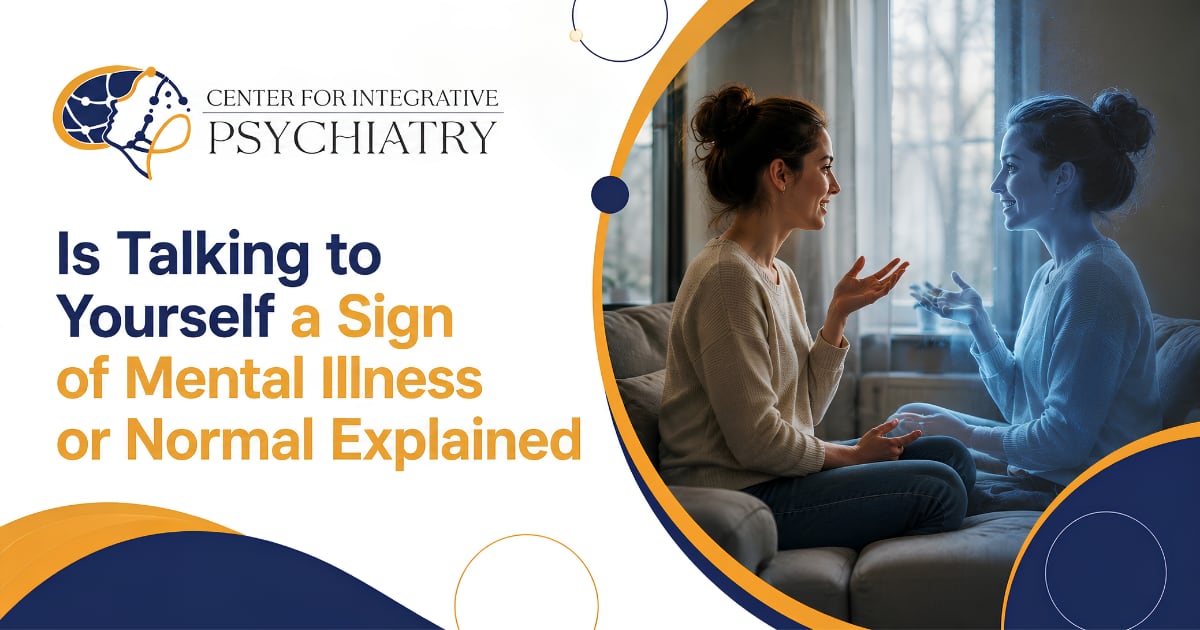
Many people occasionally speak out loud while alone. You might catch yourself rehearsing a conversation or muttering instructions. Have you wondered is talking to yourself a sign of mental illness or completely normal? Understanding the boundary between healthy inner processing and psychiatric distress provides reassurance and clarity.
At Texas CIP, we deliver compassionate, evidence-based psychiatric care to help individuals navigate complex mental health challenges. Our comprehensive services include Telehealth, Mental Health Therapy, TMS (Transcranial Magnetic Stimulation), Medication Management, Functional Psychiatry, Life Coaching, Nutritional Psychiatry, and Naturopathy. Whether managing Schizophrenia and Psychosis, Anxiety Disorders, OCD, Bipolar Disorder, Major Depression, PTSD, ADHD, or Grief and Loss, our multidisciplinary team creates personalized treatment pathways designed to restore peace and emotional balance.
Is Talking To Yourself A Sign Of Mental Illness?
To determine is talking to yourself a sign of mental illness, clinicians look at context, awareness, and intent. In most cases, self-talk is a harmless and automatic cognitive tool that helps individuals process thoughts, manage emotions, and focus attention.
However, when out-loud dialogue occurs without conscious control or responds to external unseen voices, it may indicate underlying psychiatric conditions. Distinguishing between purposeful self-talk and involuntary vocal responses helps guide appropriate medical evaluation and care.
Psychiatric professionals evaluate several factors when determining whether out-loud dialogue warrants clinical support:
- Awareness And Control: Conscious self-talk involves deliberate inner or outer dialogue, whereas involuntary vocalization often occurs without personal control.
- Presence Of Hallucinations: Healthy self-talk originates from your own thoughts, while psychotic spectrum disorders involve hearing external unseen voices.
- Emotional State: Purposeful talking usually calms confusion or organizes thoughts, while psychiatric symptoms often accompany severe fear, agitation, or paranoid delusions.
- Impact On Daily Functioning: Harmless self-talk does not impair social relationships or work duties, whereas unmanaged clinical symptoms frequently disrupt daily life.
Is It Normal To Talk To Yourself Out Loud?
Many people worry about their habits and ask is it normal to talk to yourself out loud during quiet moments. Psychologists confirm that out-loud dialogue is a common human behavior that begins early in childhood development.
Young children frequently speak out loud to guide their play and learn self-regulation. As adults mature, this external dialogue usually transitions into an internal monologue, but speaking out loud often resurfaces during periods of high concentration, stress, or problem-solving.
Research reveals several reasons why out-loud dialogue remains a functional cognitive tool for adults:
- Cognitive Focus: Verbalizing tasks out loud helps direct attention, improve memory recall, and filter out surrounding distractions.
- Emotional Regulation: Vocalizing feelings during frustrating moments helps process complex emotions and reduce immediate internal tension.
- Goal Alignment: Talking through sequential steps out loud clarifies decision-making processes when tackling difficult projects.
- Memory Enhancement: Reading instructions or lists out loud reinforces neural pathways, making information easier to retain.
How Many People Talk To Themselves?
Individuals often feel embarrassed by their private habits and wonder how many people talk to themselves on a regular basis. Observational studies suggest that almost everyone engages in some form of internal or external self-talk throughout their lives.
When evaluating is it weird to talk to yourself, researchers emphasize that private speech occurs across all cultures and age groups. Estimates indicate that over ninety percent of adults engage in verbal self-talk, with a significant majority speaking out loud when working through challenging tasks or isolated situations.
Understanding how common this habit is helps normalize private speech:
- Universal Practice: Nearly all individuals utilize internal dialogue to process memories, plan schedules, and navigate daily stress.
- Frequent Out-Loud Speech: Research indicates that most adults speak out loud to themselves daily when alone or highly focused.
- Heightened Stress Response: Frequency of out-loud speech naturally increases during periods of isolation, intense workload, or sudden life transitions.
- Developmental Continuity: Out-loud dialogue remains a continuous lifelong strategy for organizing thoughts rather than a developmental regression.
What It Is Called When You Talk To Yourself And What Causes It?
When exploring what it is called when you talk to yourself, linguists and psychologists use terms like private speech, self-talk, or internal monologue. When spoken aloud to oneself, it is formally known as externalized self-talk or solitary dialogue.
Understanding what causes people to talk to themselves requires examining both healthy cognitive triggers and underlying biological stressors. Knowing why do people talk to themselves helps clarify when the behavior serves a healthy purpose and when it stems from neurochemical distress.
Common triggers and root causes for out-loud speech fall into several categories:
- High Cognitive Load: Complex problem-solving prompts the brain to use auditory channels to process multi-step logic.
- Isolation And Loneliness: Spending extended periods alone leads individuals to speak out loud for comfort and cognitive stimulation.
- Neurodevelopmental Differences: Individuals with ADHD or Autism Spectrum conditions often use external speech to regulate attention and sensory input.
- Psychotic Spectrum Conditions: Altered brain chemistry in conditions like Schizophrenia causes individuals to respond out loud to auditory hallucinations.
What Does It Mean When Someone Talks To Themselves?
Caregivers and family members frequently ask what does it mean when someone talks to themselves uncontrollably or in public settings. When out-loud dialogue is disjointed, hostile, or directed at invisible entities, it may signal an underlying neurological or psychiatric crisis.
Auditory hallucinations occur when altered neurotransmitter signaling causes the brain to perceive sounds or voices that have no external source. Individuals experiencing psychosis may speak out loud to answer, argue with, or defend themselves against these intrusive auditory experiences.
Recognizing key differences between healthy self-talk and psychotic symptoms ensures timely intervention:
- Coherence Of Speech: Healthy self-talk follows logical thought patterns, while psychotic speech may sound disorganized or fragmented.
- Emotional Response: Responding to auditory hallucinations often triggers extreme distress, panic, anger, or intense hypervigilance.
- Unseen Entities: Psychotic dialogue frequently involves arguing with unseen voices that feel entirely separate from the person's own mind.
- Loss Of Reality Testing: Individuals experiencing psychosis may firmly believe external voices are real, lacking awareness that the experience originates within the brain.
How Texas CIP Diagnoses And Treats Psychiatric Symptoms
When out-loud dialogue is accompanied by distress, confusion, or behavioral shifts, seeking a professional medical evaluation is essential. At Texas CIP, our psychiatric specialists in Dallas perform comprehensive evaluations to determine the exact root causes of behavioral and sensory changes.
Our multidisciplinary clinical team differentiates between stress-induced behavior, neurodevelopmental traits, and psychotic disorders like Schizophrenia or severe Bipolar Disorder. By combining advanced diagnostic tools with Functional Psychiatry, we build targeted recovery plans for every patient.
Our integrated treatment pathways address both biological signaling and emotional health:
- Comprehensive Psychiatric Evaluations: Conducting thorough diagnostic interviews to evaluate speech patterns, cognitive function, and potential hallucinatory experiences.
- Targeted Medication Management: Calibrating advanced psychiatric prescriptions to stabilize neurotransmitter activity and reduce intrusive auditory voices.
- Non-Invasive TMS Therapy: Utilizing Transcranial Magnetic Stimulation to rebalance neural circuits involved in mood regulation and cognitive clarity.
- Nutritional Psychiatry: Identifying metabolic imbalances, gut-brain disruptions, and nutrient deficiencies that impact central nervous system stability.
- Life Coaching: Providing life coaching to help individuals manage stress, improve social functioning, and build resilience.
Final Thoughts
Determining whether is talking to yourself a sign of mental illness depends on awareness, intent, and reality testing. While intentional out-loud speech is a normal cognitive tool used for focus and stress relief, involuntary dialogue responding to unseen voices requires specialized medical care.
At Texas CIP, our multidisciplinary team is dedicated to providing compassionate, comprehensive support for all mental health concerns. Contact Texas CIP today to schedule a consultation and learn how our personalized therapy, psychiatric management, TMS, and functional wellness programs can help you or your loved one achieve clarity and lasting well-being.
Frequently asked questions
- Who Should Consult A Specialist About Out-Loud Self-Talk?
- You should consult a psychiatric professional if out-loud speech is accompanied by distress, confusion, social withdrawal, or responding to unseen voices.
- What Is The Difference Between Healthy Self-Talk And Auditory Hallucinations?
- Healthy self-talk is a conscious internal or external dialogue originating from your own thoughts, whereas auditory hallucinations feel like external voices beyond your control.
- When Is It Normal To Talk To Yourself Out Loud?
- Speaking out loud is completely normal when you are problem-solving, trying to focus, managing stress, or working through complex tasks alone.
- Where Can You Receive Professional Evaluation For Psychotic Symptoms In Texas?
- Texas CIP offers integrated in-person and virtual Telehealth services across Texas, providing specialized psychiatry, TMS, therapy, and functional medicine.
- Why Do People Respond Out Loud To Auditory Hallucinations?
- Altered brain chemistry makes auditory hallucinations feel completely real, prompting individuals to answer, argue, or react to the voices they perceive.
- How Can Texas CIP Help Treat Conditions Involving Hallucinations Or Psychosis?
- Texas CIP combines precise Medication Management, TMS therapy, Mental Health Therapy, Functional Psychiatry, and Life Coaching to restore neurochemical balance and cognitive health.
This article is for education and general information. It isn't a substitute for individual medical advice, diagnosis, or treatment from a qualified clinician.
Webmaster
Articles on this blog are educational resources from the Center for Integrative Psychiatry, a multidisciplinary clinic offering evidence-based psychiatry, therapy, TMS, and integrative care for Texans since 2015. They are not medical advice — always talk with your own clinician about your care.
Meet the CIP team