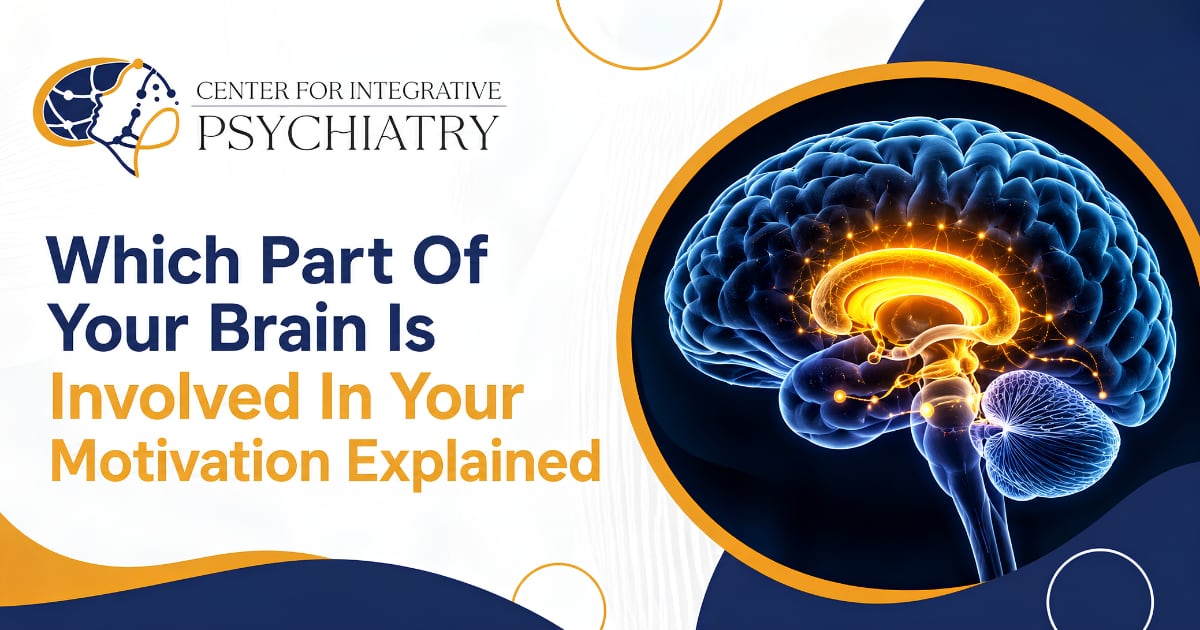
Motivation drives every goal and decision in your life. Have you ever wondered which part of your brain is involved in your motivation? Your neural circuitry determines how you feel, focus, and take action. Understanding this brain network empowers you to regain your natural energy.
At Texas CIP, we specialize in optimizing brain health and helping individuals regain their vitality. Our comprehensive care options include Telehealth, Mental Health Therapy, TMS (Transcranial Magnetic Stimulation), Medication Management, Functional Psychiatry, Life Coaching, Nutritional Psychiatry, and Naturopathy. Whether you are living with Depression, ADHD, Anxiety Disorders, OCD, PTSD, Bipolar Disorder, Grief and Loss, or Schizophrenia and Psychosis, our personalized therapies work to restore your cognitive balance and daily drive.
What Part Of The Brain Controls Motivation?
When exploring what part of the brain controls motivation, scientists look at an interconnected neural circuit rather than a single organ. Motivation is a complex cognitive process that relies on communication between your primitive emotional center and your advanced executive control center.
The primary neural circuit driving human action is the mesolimbic dopamine pathway. This system connects deep midbrain structures with your frontal cortex. When you set a goal, these regions exchange chemical signals to calculate effort versus reward, prompting your body to take action.
Understanding which part of your brain is involved in your motivation helps explain why emotional stress or neurochemical imbalances can make simple daily tasks feel impossible. When this circuit is healthy, dopamine flows smoothly, giving you the focus and enthusiasm needed to complete daily activities.
Where Is The Reward Center In The Brain And How Does It Work?
To understand where does motivation come from, you must examine the human reward circuit. The nucleus accumbens and the ventral tegmental area (VTA) form the foundation of this system.
If you are curious where is the reward center in the brain, it is located deep within the limbic system beneath the cerebral cortex. This region acts as your brain’s primary engine for desire and positive reinforcement:
- Ventral Tegmental Area (VTA): Synthesizes dopamine and dispatches it across various brain regions whenever you anticipate a rewarding outcome.
- Nucleus Accumbens: Processes reward signals and evaluates whether an action is worth the physical or mental effort required.
- Amygdala: Assigns emotional significance to memories and environmental cues, reinforcing your desire to repeat rewarding activities.
Together, these structures create the neurochemical urge that fuels ambition. Without proper dopamine signaling in these limbic structures, your brain loses its ability to anticipate pleasure or success, causing drive to collapse.
The Prefrontal Cortex: The Part Of Your Brain That’s Responsible For Willpower
While the limbic system generates raw desire, the reasoning part of the brain ensures that your desires translate into structured action. Located directly behind your forehead, the prefrontal cortex manages high-level decision-making, long-term planning, and emotional self-regulation.
Neuroscientists often identify this region as the part of your brain that’s responsible for willpower. It evaluates competing choices, controls impulses, and keeps you focused on long-term rewards even when immediate gratification tempts you.
Key functions managed by the prefrontal cortex include:
- Inhibiting impulsive distractions to keep you focused on prioritized tasks.
- Calculating long-term benefits versus short-term discomfort or physical effort.
- Organizing complex daily goals into manageable, step-by-step action plans.
- Regulating stress responses so emotional overload does not paralyze your productivity.
The Brain And Motivation: What Does Each Side Of The Brain Control?
When examining the brain and motivation, structural symmetry plays a unique role. Both cerebral hemispheres contribute to your emotional drive, but they process goals and environmental threats in distinct ways.
Understanding what does each side of the brain control helps clarify how your mental state shapes your daily behavior:
- Left Hemisphere: Dominates approach-oriented motivation. It activates when you feel optimistic, goal-driven, and eager to pursue rewards. Higher activity in the left prefrontal cortex correlates with enthusiasm and resilience.
- Right Hemisphere: Dominates avoidance-oriented motivation. It processes caution, risk assessment, and fear. When the right hemisphere is hyperactive, you may feel defensive, anxious, or hesitant to start new tasks.
A healthy brain maintains a balanced dialogue between both hemispheres. When emotional distress disrupts this harmony, avoidance behaviors often overpower your natural drive to achieve.
How Mental Health Conditions Disrupt Brain Motivation
Your brain relies on delicate chemical signaling to maintain daily motivation. When mental health conditions develop, they disrupt neurotransmitter levels and impair communication across your motivation circuits.
Specific conditions alter motivation pathways in distinct ways:
- Depression: Suppresses dopamine production in the reward center, causing severe anhedonia and an inability to feel motivated.
- ADHD: Impairs executive functions within the prefrontal cortex, making attention management and self-discipline extremely difficult.
- Anxiety Disorders: Hyperactivate the amygdala and right hemisphere, shifting your brain into survival mode rather than goal-seeking mode.
- Bipolar Disorder: Create chaotic signaling loops that disrupt sustained focus, mood stability, and cognitive energy.
Recognizing these biological roots removes shame from a lack of drive. Reduced willpower is often a biological symptom of underlying distress rather than a personal failure.
How Texas CIP Restores Brain Function And Motivation
Restoring your natural drive requires a comprehensive approach that treats both the biological and psychological aspects of brain function. At Texas CIP, our integrative therapies target the root causes of neural exhaustion and chemical imbalances.
Our multidisciplinary services work together to rebuild cognitive health and inner motivation:
- TMS (Transcranial Magnetic Stimulation): Uses non-invasive magnetic pulses to stimulate underactive regions in the prefrontal cortex, restoring dopamine activity and brain network connectivity.
- Nutritional Psychiatry: Identifies nutritional deficiencies, systemic inflammation, and metabolic imbalances that deplete brain chemicals like dopamine and serotonin.
- Mental Health Therapy: Provides evidence-based cognitive strategies to reframe negative thought patterns and reduce anxiety-driven paralysis.
- Medication Management: Calibrates essential psychiatric medications to optimize neurotransmitter signaling in your brain’s reward centers.
- Naturopathy: Equips you with lifestyle routines, stress-management tools, and behavioral structures that promote long-term cognitive endurance.
Final Thoughts
Understanding which part of your brain is involved in your motivation reveals that drive relies on a balanced neural network. From the limbic reward center to the executive prefrontal cortex, every section must work in harmony for you to thrive.
If chronic stress, mental fatigue, or psychological conditions have depleted your drive, expert help is available. Contact Texas CIP today to learn how our personalized mental health therapies, TMS, and functional psychiatry services can help you reignite your focus and vitality.
Frequently asked questions
- Who Regulates Dopamine Production In The Brain For Motivation?
- Dopamine is produced primarily by neurons in the Ventral Tegmental Area (VTA) and the substantia nigra, which send motivation signals directly to the reward center.
- What Part Of The Brain Controls Motivation And Willpower Daily?
- The prefrontal cortex acts as the main control center for willpower and planning, while the nucleus accumbens drives raw emotional desire and reward processing.
- When Should You Seek Professional Help For A Loss Of Motivation?
- You should seek professional support when a lack of drive lasts for more than two weeks, interferes with daily work, or occurs alongside symptoms of depression or anxiety.
- Where Is The Reward Center In The Brain Located Exactly?
- The reward center is situated deep in the subcortical limbic system, primarily centered around the nucleus accumbens and Ventral Tegmental Area.
- Why Does Chronic Stress Ruin Your Brain Motivation Networks?
- Chronic stress floods your nervous system with cortisol, which damages prefrontal synaptic connections and disrupts normal dopamine production in the reward center.
- How Can Texas CIP Help You Rebuild Brain Drive And Focus?
- Texas CIP offers advanced TMS, Functional Psychiatry, Medication Management, and individualized therapies to repair damaged neural pathways and restore neurotransmitter balance.
This article is for education and general information. It isn't a substitute for individual medical advice, diagnosis, or treatment from a qualified clinician.
Webmaster
Articles on this blog are educational resources from the Center for Integrative Psychiatry, a multidisciplinary clinic offering evidence-based psychiatry, therapy, TMS, and integrative care for Texans since 2015. They are not medical advice — always talk with your own clinician about your care.
Meet the CIP team